Good, Better, Excellent: Using Differential Reinforcement to Shape Stronger Behavior (Part 2)
In Part 1, we explored differential reinforcement as a way to help your dog choose a useful behavior when something else has been getting in the way. We focused on DRI, Differential Reinforcement of Incompatible Behavior, and asked a practical question: What could my dog do instead?
Now we can take differential reinforcement in another direction. Once your dog understands a behavior, you can begin noticing differences in how they perform it. One response may come quickly. Another may show greater precision. We use the term Differential Reinforcement of Excellent Behavior, or DRE, for selectively giving greater reinforcement to those stronger performances. The idea gives you a way to communicate something more specific than “yes, that worked.” Your reinforcement can also say, “That was especially good. Try that again.”
First, Your Dog Needs to Know the Game
Imagine you are teaching your dog to come when called. Early in the learning process, your dog turns toward you and starts moving in your direction. Reinforcing that response helps them discover what the cue means.
As the behavior becomes familiar, you may start seeing different versions of it. Sometimes your dog responds immediately. Another time, they take a moment before heading your way.
Those differences give you something to work with, but your criteria should match your dog's current understanding. Early learning benefits from plenty of clear feedback. Your dog needs enough successful repetitions to understand which behavior earns reinforcement. As that understanding develops, you can begin asking a more precise question: Which version would I love to see more often? Now DRE has a useful job to do.
Let the Reward Carry More Information
Reinforcement tells your dog that something they just did worked. DRE makes that feedback more precise because the outcome can reflect the quality of the performance. Suppose your dog already understands recall. A steady response may earn the familiar reinforcement they expect. When they turn immediately and hurry back to you, you can make that particular response more rewarding. The difference might come from value. A familiar treat can reinforce a familiar performance. Something your dog especially enjoys can mark a stronger one.
Quantity can communicate a difference too. A particularly useful response might earn a larger-than-usual reward. That change helps the moment stand out from the repetitions around it. What matters most is how your dog experiences the reward. One dog may work enthusiastically for food, while another values play more. Knowing what matters to your dog gives you more useful ways to communicate.
How Dude Learned to Say “Ah-roo”
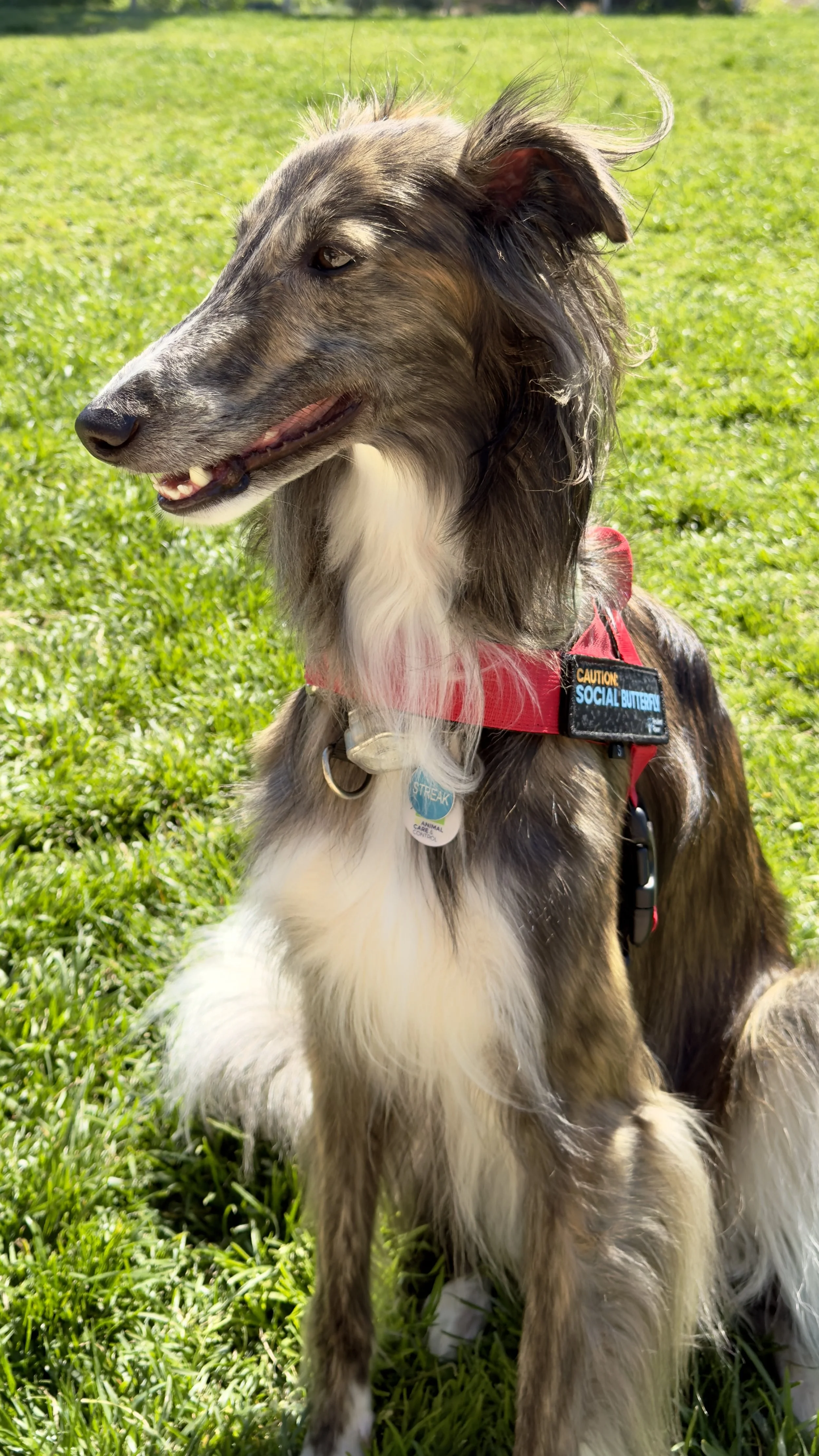
Dude gave us one of our favorite examples of DRE. He has a wonderfully expressive low growl-howl. We wanted to see whether we could shape that sound into a distinct two-syllable “Ah-roo.” At first, precision could wait. We wanted him to discover that vocalizing was part of the game, so a “roo” earned an enthusiastic jackpot. That response stood out from the ordinary reinforcement he received for familiar behaviors. He quickly began offering the sound more often.
Once Dude was speaking reliably, we could listen for something more specific. A regular “roo” still earned a regular reward during that stage. When he gave us the two syllables we wanted, “Ah-roo” earned something he valued more. Dude could experience the difference between those outcomes. He offered a sound, then our response gave him information about what worked especially well. On the next repetition, he had another opportunity to try.
Eventually, “Ah-roo” became familiar enough that we could raise the criteria again. We began reserving reinforcement for the more precise version. Dude had moved from discovering that vocalizing paid off to understanding which vocalization we were listening for. This process is called shaping. You reinforce progress toward a more specific behavior, then adjust your criteria as your dog's understanding develops.
Raise the Criteria With Your Dog
DRE requires you to pay close attention to what your dog can already do. Excellent should describe progress relative to the dog in front of you and the skill they are learning.
A response that earns a big celebration today may become familiar with practice. That change gives you evidence that your dog has learned something. You can then decide whether the behavior serves your needs already or whether another level of refinement would be useful. Watch for patterns across several repetitions. If the stronger version begins appearing regularly, your dog may be ready for more precise criteria. You can gradually direct the most meaningful reinforcement toward the response you want to strengthen. Your dog may also tell you that you moved ahead too quickly. A behavior that had been flowing easily may suddenly become hesitant. That information gives you a reason to reconsider the difficulty and make the next repetition clearer.
This makes shaping collaborative. You decide what you are working toward, while your dog's performance helps you decide how quickly to move.
Precision Asks Something From You, Too
As your criteria become more specific, your observation has to become more specific. Your dog can use differences in reinforcement most effectively when those differences connect clearly to what they just did.
Decide what you are looking for before you begin a training session. With Dude, we eventually listened for two clear syllables. That gave us a criterion we could recognize quickly. For another behavior, the important distinction may be speed. If you are strengthening recall, you might decide that an immediate turn toward you deserves greater reinforcement. Now you know exactly which moment you are watching for.
Clear criteria also help you stay consistent. If the definition of an excellent response keeps changing during the session, your feedback becomes harder for your dog to interpret. Knowing what matters before you start allows you to respond with better timing. This is one of the reasons training develops skills on both ends of the leash. Your dog learns to make finer distinctions. You learn to observe and communicate those distinctions with greater clarity.
Let Excellent Develop
A beautiful repetition can make you want the next one to look exactly the same. Your dog may have other ideas.
They might give you a fantastic response and follow it with an ordinary one. The stronger response still gives you useful information. Your dog has shown that the behavior is available, and you can create more opportunities for them to discover what makes that version especially rewarding. Give the learning process room to develop. Reinforcement can guide your dog toward greater precision through repeated experiences. You can adjust your feedback as the stronger behavior becomes easier for them to offer. Eventually, yesterday's excellent response may become today's familiar one. That gives you another choice. You can enjoy the behavior you have built together or decide that there is another useful refinement worth exploring.
Training Becomes a Conversation
DRE can improve performance, but the more interesting opportunity comes from the exchange happening between you and your dog. Your dog offers behavior. You observe what they did and respond in a way that carries information. Then your dog gets another turn. They may offer the behavior again with a small variation. Your response helps them discover which choices lead toward the outcome they value.
A few minutes of training can contain dozens of these exchanges. You begin noticing details in your dog's behavior that you might once have missed. Your dog begins paying closer attention to the information your reinforcement provides. The two of you are learning how to understand each other more precisely.
That experience sits at the heart of We Train People to Speak Dog. Communication travels both ways. You learn to read what your dog offers, while your responses help them understand what you are inviting them to do. DRE can help you refine an important life skill or teach something simply because it makes both of you smile. The behavior may be the reason you started training, but the learning happening between you can become the more interesting part.
In Part 1, we asked, “What could my dog do instead?” With DRE, the question evolves: “What did my dog just do that I would love to see more of?” When you can answer that clearly, your reinforcement can help your dog discover how to offer it again.