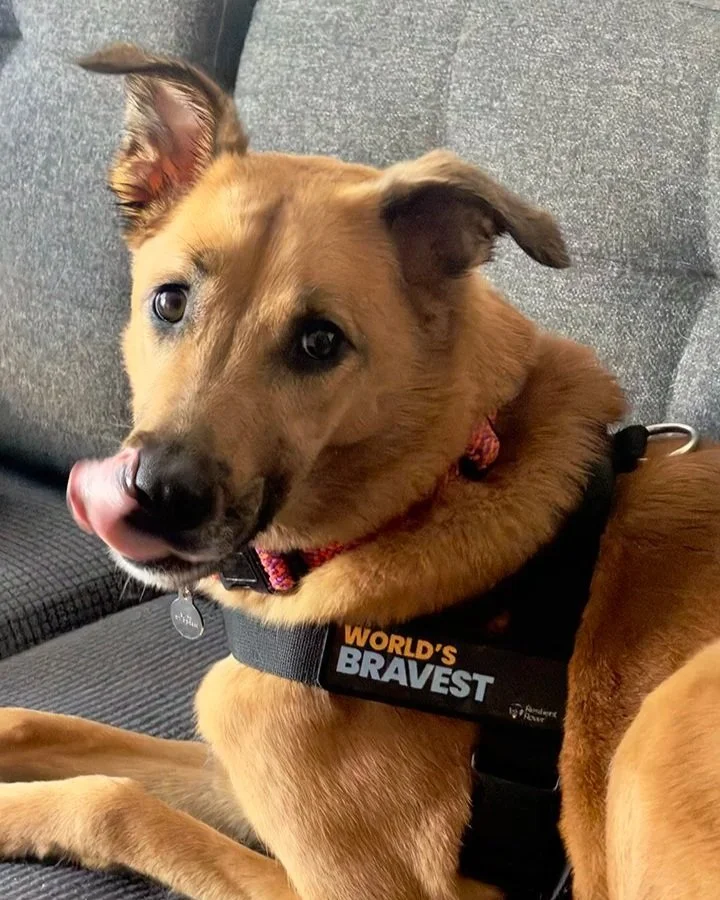
For sweet, timid Blaire, ordinary parts of daily life were too much. She lived with Wendy in Pinole, where footsteps, voices, cooking sounds, birds, even a sneeze from another room could send her back into the crate. The appearance of a harness and leash, or the medication for her ears all made her retreat.
But Blaire had quieter ways of expressing discomfort. She might turn her head, look away, move her ears back, show whites in her eyes, become still, or freeze. Wendy wanted to respect those signals while still helping Blaire take part in the necessary routines of everyday life.
Across walks, harnesses, stairs, cars, sounds, and ear care, willingness became the thread connecting the work. Our role was to help Wendy see the information Blaire was already offering and use it to decide what came next.
The Walk Begins Inside
Going outside had become particularly difficult after Wendy and Blaire moved. Blaire mostly preferred staying in her room unless she knew she was headed somewhere she genuinely enjoyed. The journey from that room to the outside world contained several scary places where she would shut down, freeze, or retreat back into her crate.
The harness came first, and that was usually a non-starter for her. Then Blaire needed to leave the room, move through the hallway, approach the stairs, go down them, reach the front door, and finally step outside. Returning home was usually a relief, but sometimes even getting back inside could bring its own hesitation. Blaire might remain lying in the car, turn head, show whale eye, or plant while Wendy worked through the practical reality of getting them both inside.
We helped Wendy see the early signs, and begin shortening the outings when Blaire showed her they were difficult. She noticed that Blaire responded to being heard…spending a little less time on edge. That alone gave us a lot of useful information about how much the structure and length of the outing itself mattered. Together, we broke the journey into tiny micro-moments, and helped Blaire learn how rewarding it would be to approach each one willingly. A trip into the hallway could be enough for one practice session, while another might include approaching the stairs or moving a few steps down them.
Five Steps Can Tell You a Lot
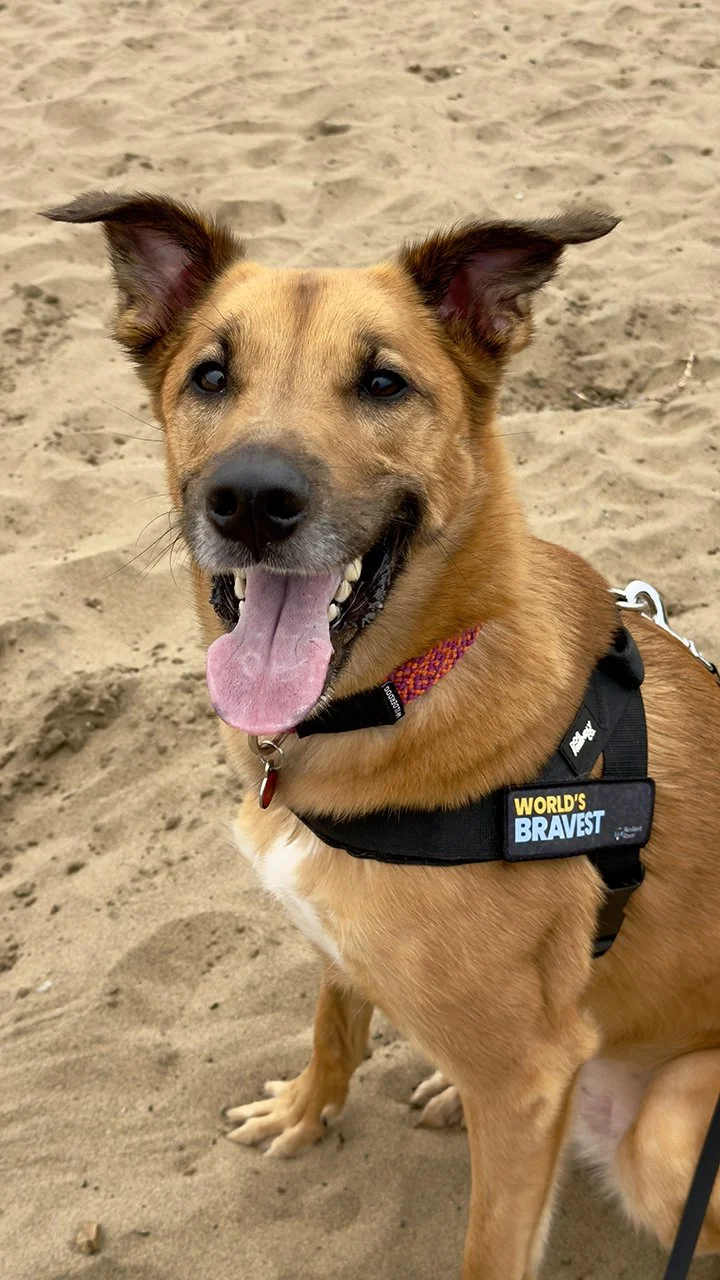
What Blaire looked like while taking those steps gave Wendy the most useful information. Could she still play, eat, investigate, connect, and choose to keep moving?
Five steps down the staircase with a dog who still wanted to play told Wendy plenty. Blaire’s body and behavior helped her recognize when the activity remained manageable and when making the next step smaller would serve her better. That changed what counted as progress. A playful response in the hallway, a glance toward something difficult, or another willing step could each become useful information and something worth building on. Wendy was learning to read the quality of Blaire’s movement through the world. Distance still mattered, and curiosity, play, engagement, initiative, and recovery gave her a much richer picture of how Blaire felt.
The Harness Became a Question, not a Command
The harness gave Wendy another place to practice reading Blaire closely. She could present it, watch Blaire’s response, reward interest, pause for a check-in, and invite the next part when Blaire remained engaged. Blaire might look toward the harness, stay nearby, investigate it, or allow it to touch her body. Each response gave Wendy information about whether to continue, pause, or make the next step easier.
The same approach became especially useful around Blaire’s ears. Recurring ear problems meant recurring treatment, and the equipment associated with that care had developed strong emotional significance for her. Wendy made the routine more predictable and watched the small details carefully. Blaire could investigate the equipment, pair its presence with things she enjoyed, and practice touch around her ears in manageable pieces while Wendy observed whether she stayed connected. A head turn, a shift away, continued play, moving closer, or remaining present all gave Wendy something concrete to read. What once could feel like a difficult routine became another place where Blaire’s response helped guide the next step.
Wendy Changed Her Side Too
Most of our coaching with Wendy happened virtually, so she did the overwhelming majority of Blaire’s day-to-day work herself. Our job was to help her notice more, interpret what she saw in context, and build practical ways to respond.
Week after week, Wendy adjusted her movement, timing, touch, expectations, and use of food and play according to what Blaire showed her. The more precisely she observed, the more confidently she could decide whether to pause, continue, simplify, or invite another step.
One affectionate interaction captured that change particularly well. Wendy initially read Blaire’s ear position as nervousness, then looked at Blaire’s whole body and engagement and realized those ears carried different information in that moment. Wendy summed up the larger lesson during an early session: “I’m gonna have to train myself a little bit better.” That insight sits at the heart of their story because Blaire was giving information all along, and Wendy was becoming increasingly fluent in how to read it.
Then Blaire Started Asking
Blaire later stayed with us on two occasions when her family needed boarding. Living together gave us opportunities to observe how she moved through walking, harnessing, transitions, and daily routines, and she also spent time alongside Dude.
During a later stay, Blaire began approaching the door herself. Her posture and movement told us she wanted to go outside, and she was initiating a journey that once contained many places where she would stop. Her posture outside changed too. Blaire walked with her tail up, stayed connected, and continued forward with greater ease. Those observations mattered because they gave Wendy another piece of evidence about what Blaire’s willingness could look like. The dog who once needed the journey outside divided into tiny pieces was now sometimes initiating the outing herself, and Wendy could carry that information back into their life at home.
Enter the Wiggle Monster
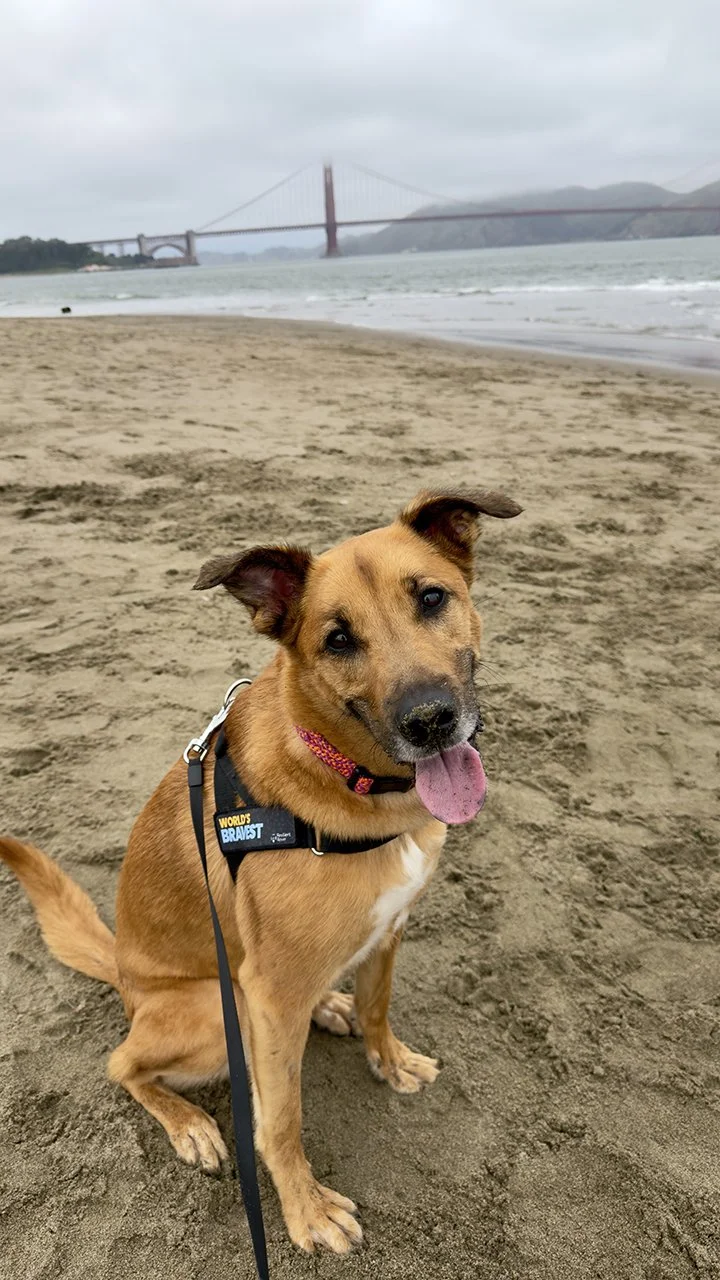
One of our favorite moments came when Wendy arrived to pick Blaire up after a stay with us. We were at a park, and as soon as Blaire saw Wendy, every part of her body seemed to join the reunion. She jumped, played, wagged, and wriggled until the extraordinarily sensitive dog we had spent so much time observing transformed into what we can only describe as a complete wiggle monster. Blaire had plenty of subtle ways to express herself, and apparently joy called for the full-body version.
The moment belonged to the relationship Wendy had worked so carefully to nurture. Week after week, she had become more attentive to Blaire’s responses and more skilled at shaping everyday routines around what she observed. A tiny head turn could carry information, and so could an entire dog wriggling with delight. Wendy was learning to read both with the same curiosity.
A Much More Wholehearted Yesss
Blaire remains an exceptionally sensitive dog, and Wendy now has a richer understanding of how that sensitivity shows up. Ear care still calls for thoughtfulness, sounds can carry enormous meaning, and some activities work best when Wendy divides them into pieces Blaire can explore at her own pace. The progress often looks wonderfully ordinary. Blaire takes a few playful steps down the stairs, stays engaged through another part of her ear care, walks outside with her tail up, or approaches the door because going somewhere sounds good to her. Those moments belong beside the toy surgeon and the world-class wiggle monster. They reveal Blaire more fully, from the quiet head turn that asks Wendy to notice to the joyful whole-body answer that leaves very little room for interpretation.
Our work helped Wendy become more fluent in those answers, and Wendy now carries that understanding into the routines they share every day. Blaire, in turn, keeps giving her more and a much more wholehearted yesss.